Managing indoor ant activity in South Florida requires distinguishing between structural wood excavators and sweet-foraging invaders. Florida carpenter ants ( Camponotus floridanus ) measure roughly 5.5 to 11…
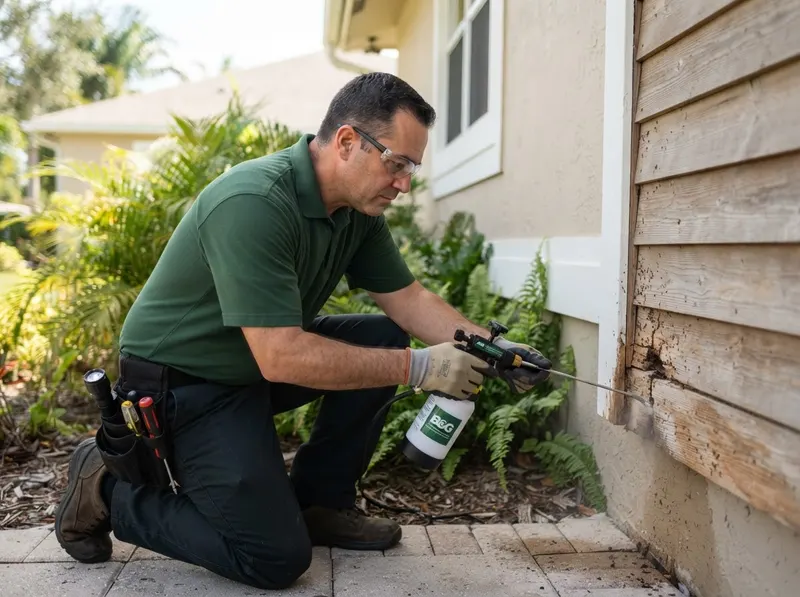
Managing indoor ant activity in South Florida requires distinguishing between structural wood excavators and sweet-foraging invaders. Florida carpenter ants (Camponotus floridanus) measure roughly 5.5 to 11 millimeters and nest inside damp structural members, fascia boards, and attic framing softened by roof leaks or high humidity. Conversely, tiny ghost ants (Tapinoma melanocephalum) measure 1.3 to 1.5 millimeters, establishing diffuse supercolonies inside baseboards, potted plants, and kitchen cabinetry. Over-the-counter pyrethroid contact sprays frequently cause ghost ant colonies to undergo budding, where reproductive queens fracture into multiple distinct sub-units across bathroom walls and kitchen counters. Effective eradication relies on slow-acting biological transfer agents that workers carry back into primary brood chambers, as documented by the University of Florida IFAS Extension.
In historic neighborhoods such as El Cid, Flamingo Park, and Grandview Heights, dense tree canopies and older architectural lumber create direct access for foraging carpenter ant trails. Structural guidelines established by the Florida Department of Agriculture and Consumer Services (FDACS) emphasize non-chemical mitigation alongside targeted intervention. EcoBarrier Extermination integrates non-repellent perimeter applications with vegetation clearance recommendations, keeping branches 12 inches away from exterior rooflines. Homes bordering canal systems or natural preserves, such as properties in RiverWalk, Ibis Golf & Country Club, and communities near Grassy Waters Preserve, experience constant ghost ant pressure during summer downpours. In these areas, water displacement drives outdoor colonies indoors through unsealed window weep holes and exterior stucco fissures.
In mid-century ranch architecture throughout SoSo (South of Southern) and Northwood Village, coastal moisture frequently causes concealed wood decay beneath exterior door thresholds and window sills. Carpenter ants hollow out these damp softwood sections without ingesting the cellulose, pushing visible wood shavings, known as frass, out of exit slits. To manage these vectors safely around children and pets, barrier micro-treatments follow principles from the EPA Citizen's Guide to Pest Control. In modern developments like Providence and Villages of Palm Beach Lakes, multi-story masonry construction requires specialized void injection along internal plumbing chases, backed by guidelines from the National Pest Management Association. High-density residential spaces in Downtown West Palm Beach receive concentrated gel micro-placements within utility conduits to interrupt foraging corridors without releasing volatile compounds into living areas.
Every job gets a firm, written price after a free on-site visit.
For standards, safe disposal, and service guidance on pest control services in West Palm Beach, FL, useful references include U.S. EPA, ENERGY STAR, U.S. Dept. of Energy, Consumer.gov, U.S. Census Bureau, and Google Maps. General consumer and small-business resources are available from USA.gov, Better Business Bureau, FTC Consumer Advice, U.S. Small Business Administration, and Ready.gov.
Tell us about your ghost and carpenter ant control job in West Palm Beach and we'll send a clear, written quote, usually the same day.
 EcoBarrier Extermination